How to convert a society patta to a JDA patta in Jaipur, and get a freehold e-patta
Who can turn a society patta into a JDA e-patta, the papers JDA asks for, the online steps on Rajasthan SSO, and how to choose freehold. With JDA sources.
PCG advisory team
Propex Consulting Group
Buying guide
PCG · Jaipur
Short answer
You apply online to JDA, through Rajasthan SSO or an e-Mitra, for the service "Issue of Lease/Free Hold Deed (E-Patta)" under Cooperative Schemes, and tick freehold if you want it. It works only for an approved cooperative scheme, a plot that exists in JDA's approved layout, a society allotment letter dated on or before 17 June 1999 and an unbroken chain of sale papers. After checks and payment, you and a witness e-sign the patta with an Aadhaar OTP, and you register it on the e-Panjiyan portal within 90 days.
In this article
JDA’s own guidebook for its online services is blunt about society pattas. It says a patta issued by a society or a developer is not a JDA patta, and that JDA “does not automatically recognize” it. Moving a plot from society patta to JDA patta means you apply to JDA, prove the plot and the chain of papers, pay what JDA demands, and receive a JDA e-patta, either leasehold or freehold.
Our earlier guides cover the background. JDA patta, society patta or freehold explains what each paper is, and how to check a JDA approved plot covers the scheme search. This guide is about the application itself, using JDA’s guidebook for end-to-end online services and its online citizen services page.
Who can convert a society patta to a JDA patta?
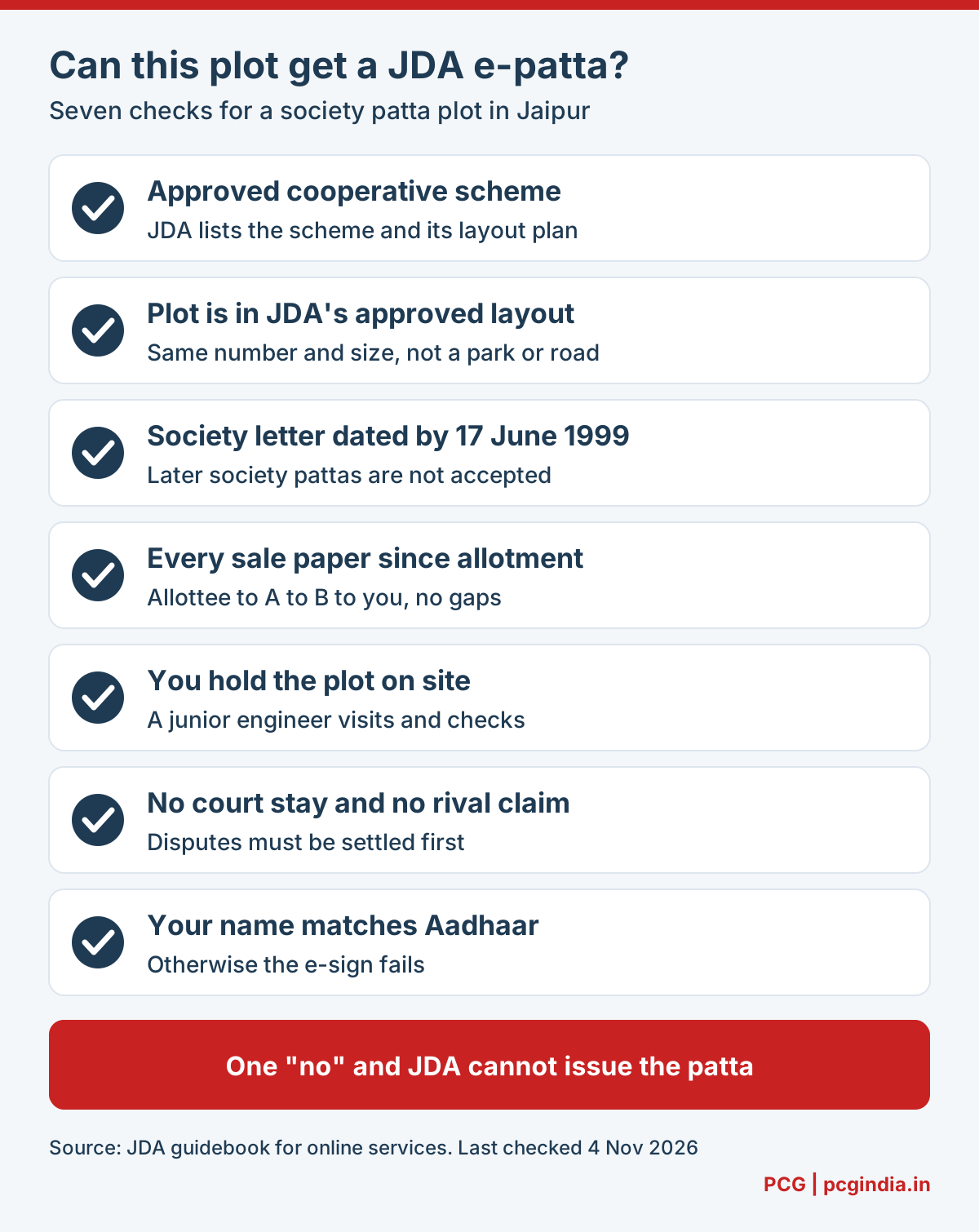
Not every plot qualifies, and JDA’s guidebook spends a whole section on the cases that fail. JDA’s portal lists the service under “Cooperative Schemes (Only Approved Schemes)”. So the first test is whether JDA approved the society’s scheme at all. You can look up the scheme and its layout plan on JDA’s Scheme and Allottees page.
The guidebook then lists the cases where JDA cannot issue an e-patta. The ones that catch society plots most often:
- The date of the society paper: allotment letters issued by cooperative societies are valid only up to 17 June 1999, the guidebook says. An application based on a society patta dated after that day is not accepted.
- A break in the chain: if the allottee sold to A, A sold to B and you bought from B, you need the papers for all three steps. One missing step, and JDA stops.
- The plot is not in the approved layout: the society’s map may show plot 55. If JDA’s approved layout has no plot 55, or a different size, or shows that spot as a park or a road, there is no patta.
- Possession: a junior engineer visits the site. If someone else holds the plot or has built on it, the file stops.
- A court order or two claimants: a stay, status quo or interim order halts JDA. Two people claiming the same plot must settle it first, before the Deputy Registrar (Cooperative Cell) or an arbitrator.
- Land marked for a road or project: no patta is issued for that part, and the guidebook says no compensation is paid.
- A name that does not match Aadhaar: the e-sign fails and the application is rejected.
What papers does JDA ask for?
For a cooperative society plot, the guidebook and JDA’s 2019 office order on lease deed documents ask for these. You upload scans and bring the originals to your counselling slot.
| Paper | Why JDA wants it |
|---|---|
| Original allotment letter from the society | Proves the first allotment. Needed even if you bought later |
| Society site plan and payment receipts | Shows the plot and that it was paid for |
| Every sale deed or transfer paper since allotment | The chain of documents, step by step |
| Photograph of the allottee in front of the plot | Must show the plot number and colony name |
| Affidavit that there is no dispute | E-signed after paying ₹50 through e-GRAS |
| Indemnity bond | E-signed after paying ₹200 through e-GRAS (society and private khatedari plots) |
| Aadhaar or another government photo ID | Your name must match it exactly |
| A witness’s Aadhaar, voter ID, passport or driving licence | Every application needs one witness |
The ₹50 and ₹200 figures are from JDA’s guidebook, read on 4 November 2026. They can change, so check the amount shown on the portal when you apply.
Some cases need more. If the allottee has died, JDA wants the death certificate, the will, a family tree and relinquishment deeds from the other heirs. If a bank holds the originals, it needs a letter from the bank not older than six months.
How to apply for a JDA e-patta online, step by step
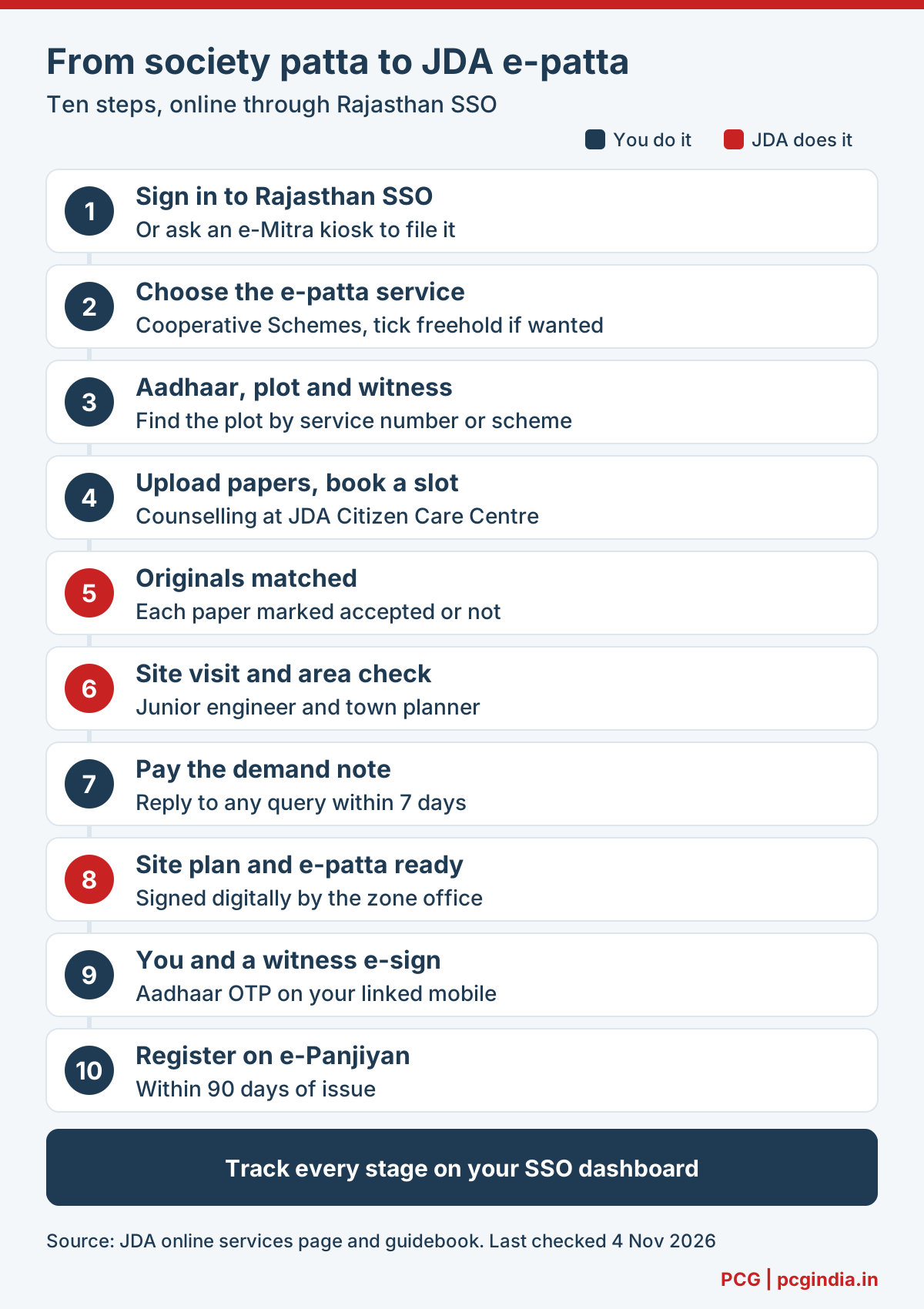
- Sign in. Use Rajasthan SSO and open JDA’s online services. An e-Mitra kiosk can file it for you.
- Pick the service. Choose “Issue of [Lease/Free Hold] Deed (E-Patta)”, then “Cooperative Schemes (Only Approved Schemes)”, then your mode, for example “Purchased from Original Allottee Through Sale Deed”. Tick the freehold box if you want a freehold patta.
- Fill in your details. Enter your Aadhaar number or virtual ID. The form pulls your name, address and photo from Aadhaar.
- Find the plot. Use the property service number, or search by scheme name. Check the plot number and area before you confirm.
- Add a witness and upload the papers. Then book a counselling date at JDA’s Citizen Care Centre and submit.
- Take the originals. The counsellor matches them with your uploads and marks each one accepted or not.
- Let the zone office check. Staff check the ownership chain, a junior engineer inspects the site, and the assistant town planner checks the area against the approved layout.
- Pay the demand. The accountant works out the amount and a demand note appears on your dashboard. JDA’s portal says queries must be answered within 7 days.
- E-sign. JDA prepares a digitally signed site plan, and the zone deputy commissioner sends the e-patta to you. You e-sign with an Aadhaar OTP, then your witness does the same.
- Register it. You get an SMS with the details to register the e-patta on e-Panjiyan, the Registration and Stamps Department’s portal. JDA says this must be done within 90 days of issue.
One thing changed this year. The Times of India reported on 18 May 2026 that JDA moved six kinds of files fully online, including freehold or lease deeds, name transfer, subdivision and the One Time Lease Certificate, with uploads made on the JDA dashboard through the applicant’s SSO ID. Officials must now record a clear reason, citing the rule, when they hold up or reject a file.
Leasehold or freehold: which box should you tick?
The guidebook puts it simply. A leasehold patta gives you the land on a long lease from JDA, and if you choose yearly lease payments you pay JDA’s lease charges every financial year. A freehold patta confirms permanent ownership.
Already hold a JDA lease deed? Then you don’t start again. JDA has a separate service, “Issue Free Hold E-Patta in lieu of already issued Patta (Lease Deed)”. You upload the registered lease deed with its site plan, an affidavit surrendering your lease rights, and a few e-signed affidavits, as set out in JDA’s December 2021 office order and chapter 6 of the guidebook.
Plot B-67 in Vaishali Nagar on our site shows the end result: a JDA patta converted to freehold, with no annual lease rent.
What will it cost?
We don’t quote a figure, because JDA works it out plot by plot. The guidebook lists what goes into the demand note for a society plot:
- a regularisation amount, based on the plot’s area
- the lease amount, taken as one lump sum
- interest on regularisation, where it applies
- sewerage charges, per square yard or metre
- any old dues on the plot
- stamp duty, worked out on the zone’s current reserve rate
For approved cooperative schemes, the regularisation amount is split: 60% goes to JDA and 40% to the state government. JDA’s online lease calculator covers JDA’s own schemes only, so for a society plot the demand note on your dashboard is the number to trust.
Buying a plot that still has only a society patta?
Then the seller should finish this process first, in the seller’s own name. Since December 2025, news reports such as this Times of India report say a plot on a society patta is registered only if the land has a conversion order and 90-A clearance. Our patta guide covers what those reports say and what they leave open. A plot that already has a registered JDA e-patta is a different paper trail from one on a society paper alone, but still ask the sub-registrar’s office what applies on the day you buy.
Before you pay a token, ask the seller three things.
Has the plot got a JDA e-patta already? If not, is there an application number you can track? And does the society allotment letter carry a date on or before 17 June 1999? If the answers are vague, ask your lawyer how to protect the token in the written agreement.
Have a society paper and not sure if it qualifies? Send us a photo of it, and we’ll tell you what JDA is likely to ask for.
Questions people ask
Can I apply through e-Mitra instead of doing it online myself?
Yes. JDA's guidebook says an applicant applies online through an SSO ID or through e-Mitra. Either way the application lands on the same JDA dashboard, and the e-sign still needs your Aadhaar-linked mobile number.
I have lost the society allotment letter. Can I still get a JDA patta?
JDA's guidebook says to file an FIR first, then ask the society for a duplicate allotment letter using the police papers. If the society no longer exists, ask its administrator or liquidator. If none of them is available, apply to the Deputy Registrar (Cooperative Cell) with all the facts.
Do I have to visit the JDA office?
Usually once. You book a counselling slot online and take your original papers to the Citizen Care Centre so they can be matched with the uploads. After that, you e-sign the e-patta online and register it on e-Panjiyan.
Is it compulsory to register the JDA patta?
Yes. JDA says you must register every lease deed it issues at the sub-registrar's office within 90 days. If you miss that, you can apply online for revalidation within three years.
My original papers are with a bank. What do I do?
Ask the bank for a letter on its letterhead saying it holds the originals. An authorised officer of the bank must sign and stamp it, and it must not be older than six months. Upload it with copies of the originals. The bank hands over the originals to JDA when the patta is prepared.
The original allottee has died. Who can apply?
An heir can apply with the death certificate, the will if there is one, and a family tree (shajra). If the heirs want the patta in one name, the others sign registered relinquishment deeds. JDA may also ask for a newspaper notice at your cost.
Can an NRI apply for a JDA e-patta?
Yes. JDA's guidebook adds three papers for NRIs on top of the normal list: a passport copy, an NRI certificate from the Indian embassy or consulate, and a power of attorney in favour of a local representative who has an Aadhaar card.
How long does a JDA e-patta take?
JDA's guidebook does not give a fixed number of days. The time depends on how complete your papers are and on the site visit. You can track every stage, and every query, on your SSO dashboard.
Sources
- JDA online citizen services (list of services, process and documents for cooperative schemes)
- JDA guidebook: Guidelines for end-to-end online services (e-patta, freehold e-patta, registration)
- JDA office order D-627, 27 Nov 2019: documents for online lease deed (patta) applications
- JDA office order D-281, 15 Dec 2021: freehold patta in place of a leasehold lease deed
- Rajasthan SSO: sign-in for JDA online services
- e-Panjiyan, Registration and Stamps Department, Rajasthan
- JDA Scheme and Allottees (approved layout plans)
- JDA calculator for lease deed and patta charges (JDA schemes only)
- Times of India, 18 May 2026: JDA to roll out trackable online civic services system
- Times of India, 5 Dec 2025: Govt stops society patta registrations
Good to know. This guide is general information and not legal advice. Rules, fees and procedures change, so confirm the current position with the issuing authority or a lawyer before you decide.
Written by the PCG advisory team
Propex Consulting Group helps buyers, sellers and tenants in Jaipur with verified plots, homes and commercial space. Questions about this guide? Call us or send an enquiry.
+91 99299 37185