
Property due diligence in Jaipur: how to verify a plot's papers before you buy
Property due diligence in Jaipur: how to verify a plot's deeds, jamabandi and JDA approval on official portals, and when to bring in a property lawyer.
PCG advisory team
Propex Consulting Group
Advisory guide
PCG · Jaipur
Short answer
Property due diligence in Jaipur means verifying a plot's papers against the offices that issued them, not just collecting them. Check four records that must agree: the registered deeds on the e-Panjiyan portal, the jamabandi and mutation on Apna Khata, the JDA scheme and patta, and any loan or court case on the plot. A sale offered on a power of attorney is a reason to walk away, and a written title opinion from a property lawyer should come before you pay a token.
In this article
- What does property due diligence in Jaipur actually check?
- Which papers can you verify yourself, and which need a property lawyer?
- The red flag worth walking away from: a sale on power of attorney
- In what order should you do it, and when do you pay?
- What we check before a plot reaches this site
- Questions people ask
- Sources
What does property due diligence in Jaipur actually check?
A patta in your hand only proves that someone printed a patta. Property due diligence in Jaipur is the work of checking that paper, and every other paper, against the office that issued it. You are not collecting documents. You are confirming that each one is genuine, current, and about the exact plot you mean to buy.
Here is the part most buyers skip. When you register a sale deed at the sub-registrar’s office, the officer records it and collects the stamp duty. Registration gives public notice that the deed exists. It does not certify that the seller owned the land.
The Supreme Court made this point in Suraj Lamp & Industries v. State of Haryana (2011): registration gives “notice to the world” and makes checking title easier, but the buyer still has to verify the title.
So due diligence comes down to four separate records agreeing with each other, about one plot and one owner.
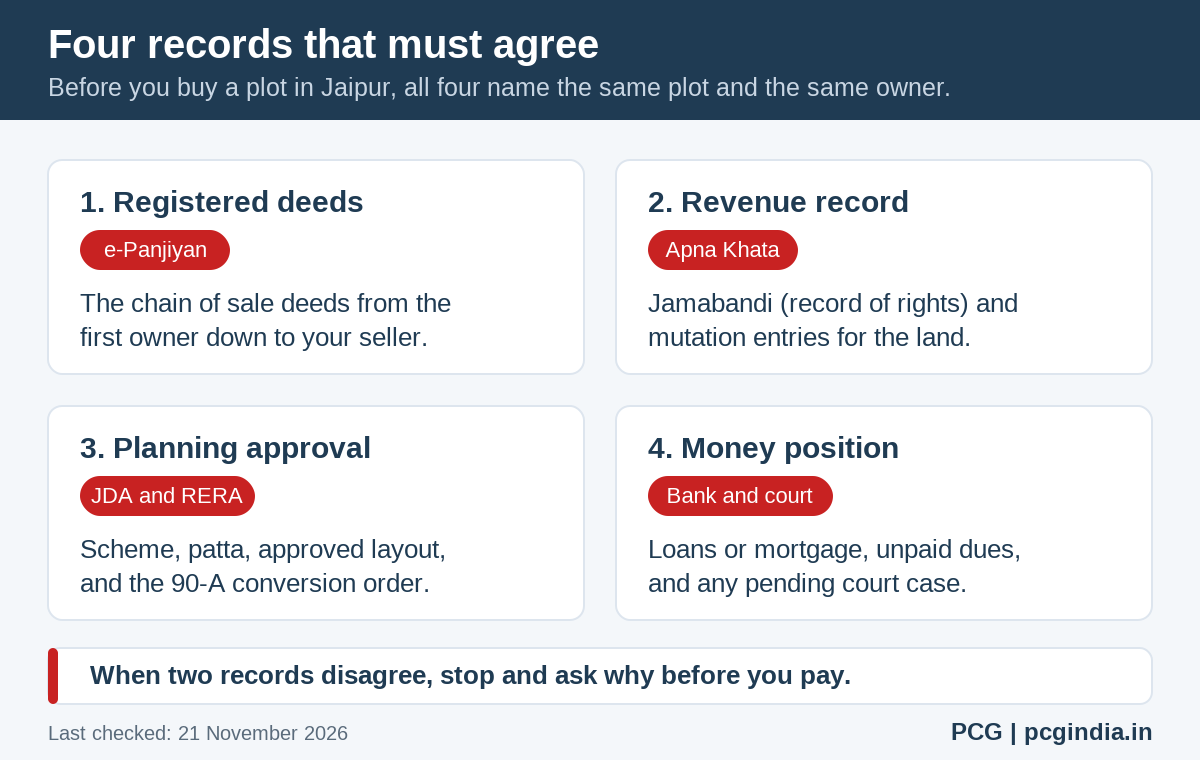
- The registered deeds: the chain of registered sale, gift or partition deeds that carried the plot from its first owner down to the person selling to you.
- The revenue record: the jamabandi (the record of rights) and the mutation (namantaran) entries the state holds for that land.
- The planning approval: the JDA scheme, the patta or lease deed, the approved layout, and the 90-A or 90-B conversion order if the land was once farmland.
- The money position: any home loan or mortgage on the plot, unpaid dues to JDA or the society, and any court case touching the land or its recent owners.
When all four name the same plot and the same owner, you have a clean picture. When two of them disagree, say a sale deed that names your seller but a jamabandi that still lists the previous owner because the mutation was never done, you have found a real problem. It is far cheaper to find it now than after you pay.
Which papers can you verify yourself, and which need a property lawyer?
More than you would expect, you can check yourself, for free, on state portals. The reading and the judgement are where a property lawyer in Jaipur earns the fee.
| Record | Check it yourself on | What a lawyer adds |
|---|---|---|
| Registered deeds | e-Panjiyan and the department’s public document search | Reads the full chain for gaps, forged links and power-of-attorney transfers |
| Jamabandi and mutation | Apna Khata | Reconciles the revenue record with the deeds and spots a missing mutation |
| JDA scheme and patta | JDA Scheme and Allottees search | Confirms the approved layout and the conversion order against the plot |
| RERA registration | Rajasthan RERA portal | Checks the promoter and the project match the brochure |
| Loans and court cases | Bank no-dues letter and court records | Searches for mortgages and pending litigation |
e-Panjiyan is the portal of the Registration and Stamps Department, run by the Inspector General of Registration and Stamps. It handles certified copies and an online search of registered documents. Rajasthan does not issue a single encumbrance certificate the way some states do. Instead you search the registered deeds, take certified copies, and have a lawyer read them for mortgages or earlier sales.
The department also runs a free public search of registered documents, where you can look a plot up by seller name, purchaser name or plot and khasra number. It gets you a first look, not proof.
For the revenue side, Apna Khata shows the jamabandi nakal and the mutation status for any land in Rajasthan. This matters most for a plot that began as farmland. For the planning side, our guide on how to check if a plot is JDA approved and our patta guide walk through the JDA Scheme and Allottees search and the online citizen services step by step. If you are buying in a new colony from a developer, also search the project on the Rajasthan RERA portal.
What you cannot do online is the part that matters most: reading the actual deeds for a break in the chain, matching the registered record against the revenue and planning records, and deciding whether a gap is fatal or fixable. The portals get you a first look. A lawyer turns that look into an opinion.
The red flag worth walking away from: a sale on power of attorney
If a seller offers a plot on a general power of attorney instead of a registered sale deed, stop. This is one of the most common ways buyers around Jaipur lose money, and the law here is clear.
In Suraj Lamp the Supreme Court held that only a registered deed of conveyance can transfer immovable property, and that a sale by power of attorney, agreement to sell or will “does not convey any title”. A power of attorney lets someone act for the owner. It does not make them the owner. Anyone who grants it can cancel it, and it lapses the day that person dies.
Sellers offer these deals to skip stamp duty or to move a plot with a weak title. For you the outcome is the same either way: you pay, and you do not get ownership that a bank or a court will back. If the seller says the sale deed “will come later”, ask what is missing, who will get it, and by when, in writing. Then show the papers to a lawyer before you part with any money.
In what order should you do it, and when do you pay?
Do the checks before you pay a token, not after. Once money has moved, you have less room to push back and the seller has less reason to fix anything.
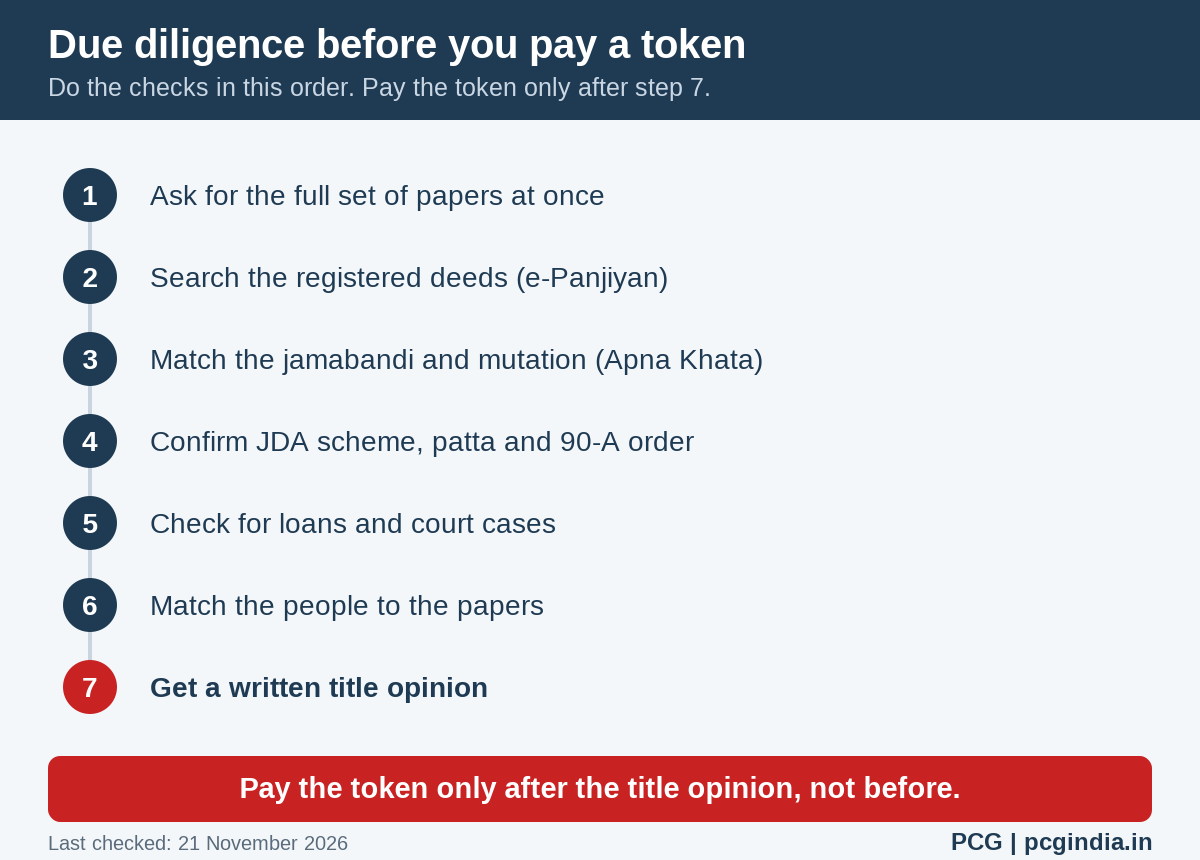
- Ask for the full set of papers together, not one at a time. A seller with clean title hands over the file. A seller who can only produce it in pieces is showing you where the gaps are.
- Search the registered deeds on e-Panjiyan and the public search, and trace the chain backwards. Lawyers usually go back about 30 years.
- Pull the jamabandi and mutation on Apna Khata and match them against the deeds. The deeds show what the parties did. The revenue record shows what the state accepted.
- Confirm the JDA scheme, the patta and the layout, and the 90-A or 90-B conversion order if the land was once farmland.
- Check for a loan on the plot and for any court case. Where a loan existed, ask for the bank’s no-dues letter, not a spoken assurance.
- Match the people to the papers. Names on the deeds against the seller’s Aadhaar and PAN, a signature from every joint owner because one co-owner cannot sell the whole plot, and, if anyone signs under a power of attorney, proof the owner is alive and that the power allows a sale.
- Get a written title opinion from a property lawyer. Pay the token only after it is in your hand.
A written opinion sets out the chain the lawyer traced, names the weak points, and gives a verdict: go ahead, go ahead only if the seller fixes something first, or step away. It also hands you a fair reason to negotiate, because a documented defect is a proper thing to raise on price.
What we check before a plot reaches this site
We check every plot on this site for ownership and approval before it goes up, the same exercise above, done once so you do not start from zero.
Plot B-67 in Vaishali Nagar carries a JDA patta converted to freehold. Plots A-8 and A-16 in Vaishali Estate each came with a JDA site plan showing the exact size, road width and setbacks. You can see more on our sold plots, and the same plots sit in our Vaishali Nagar locality guide.
This is general information on how buyers and their lawyers check a plot, not legal advice on your plot. For a title opinion, use a property lawyer. If a paper does not match, send us a photo on WhatsApp or ask us, and we will tell you what to look at next.
Questions people ask
Does registering a sale deed prove the seller owns the plot?
No. Registration records the deed and gives public notice that it exists, and it makes checking title easier, but it does not certify ownership. The Supreme Court said so in Suraj Lamp (2011). You still have to verify the title yourself or through a lawyer.
Is there an encumbrance certificate in Rajasthan?
Rajasthan does not issue a single encumbrance certificate the way some southern states do. Instead you search the registered documents on the e-Panjiyan portal and take certified copies, and a lawyer reads them for mortgages or earlier sales. Most banks accept this search.
Can I do property due diligence myself without a lawyer?
You can do the online checks yourself: the registered-deed search on e-Panjiyan, the jamabandi on Apna Khata, and the JDA scheme search. Reading the full chain of deeds for gaps, and judging whether a defect is fatal or fixable, is where a property lawyer in Jaipur is worth the fee.
How far back should the title chain go?
Lawyers in Jaipur usually trace the registered chain back about 30 years, and confirm that each deed names the previous buyer as the next seller. A break in that chain is a warning sign to settle before you buy, not after.
What is a title opinion or title search report?
It is a written note from a property lawyer. It sets out the chain of ownership they traced, lists any weak points, and advises whether to proceed, proceed only after conditions are met, or step away. Ask for it before you pay a token.
Can I buy a plot that is being sold on a power of attorney?
Be very careful. A power of attorney lets someone act for the owner, but it does not transfer ownership. Only a registered sale deed does. A power of attorney can be cancelled and it lapses when the owner dies, so ask for a registered sale deed from the real owner.
How long does property due diligence take in Jaipur?
Usually about one to two weeks, depending on how many times the plot has changed hands and how quickly the sub-registrar and revenue records come. Build the time into your agreement rather than rushing it.
Sources
- e-Panjiyan: Registration and Stamps Department, Rajasthan (IGRS)
- Rajasthan Registration and Stamps: public search of registered documents
- Apna Khata: Rajasthan land records (jamabandi and mutation)
- JDA: Scheme and Allottees search (Citizen Service)
- JDA online citizen services: certified copies, patta and conversion
- Rajasthan RERA: search registered projects
- Registration Act, 1908, section 17 (documents of which registration is compulsory)
- Supreme Court, Suraj Lamp & Industries v. State of Haryana (11 October 2011)
Good to know. This guide is general information and not legal advice. Rules, fees and procedures change, so confirm the current position with the issuing authority or a lawyer before you decide.
Written by the PCG advisory team
Propex Consulting Group helps buyers, sellers and tenants in Jaipur with verified plots, homes and commercial space. Questions about this guide? Call us or send an enquiry.
+91 99299 37185