
JDA building plan approval in Jaipur: how to get your house map sanctioned
JDA building plan approval in Jaipur: which plots need a sanctioned map, who signs it off by plot size, the online SSO steps, and the completion certificate.
PCG advisory team
Propex Consulting Group
Construction guide
PCG · Jaipur
Short answer
To build a house on your plot you need building permission from the Jaipur Development Authority before you start. Under JDA's Jaipur Region Building Regulations 2025, a plot up to 500 square metres (about 600 square yards) outside the restricted zones needs no plan approval at all: a registered architect certifies a checklist, you pay the fee online through the Rajasthan SSO portal, and JDA sends an acknowledgement in about three days. Above 500 square metres the plan must be approved by the local body or a state empanelled architect, and the setback and height rules apply either way.
In this article
- Do you need a sanctioned plan to build a house in Jaipur?
- Who signs off your house map, by plot size
- How to apply for JDA building plan approval online
- What your architect will ask you for
- The steps people skip: plinth check and completion
- Building against the plan costs more than approval
- Questions people ask
- Sources
On an ordinary residential plot in Jaipur, you may not need JDA building plan approval at all. That surprises most owners. Under the Jaipur Development Authority’s Jaipur Region Building Regulations 2025, a plot up to 500 square metres (about 600 square yards) outside the city’s restricted zones gets no plan sanctioned: a registered architect certifies a checklist, you pay the fee online, and JDA sends an acknowledgement in about three days.
Cross 500 square metres and the plan has to be approved, by the local body or a state empanelled architect. The setback and height rules bind you on every plot, approval or not. This guide covers the JDA rules for house construction that decide your route, and how to apply.
Do you need a sanctioned plan to build a house in Jaipur?
Regulation 13 of the 2025 rules sorts plots by size, and the smallest band surprises people.
A plot up to 500 square metres, outside the restricted areas, needs no plan approval. You and a registered architect, or another qualified technical person, certify the checklist in the regulations, you pay the fees, and the local body sends an acknowledgement letter within about three days. That letter is your green light. For a plot taking a fresh JDA lease deed, the rules go one step further: approval for ground plus first floor, up to 8 metres, is issued along with the patta itself.
Most Jaipur house plots sit inside this band. A 400 square yard plot, like the Kanak Vrindavan block B plot on our site, is about 334 square metres, well under the 500 line.
Read “no approval” the right way. It does not mean no rules. The setback rules, the height limit and the ground coverage all still apply, and a house built against them is unauthorised even though nobody stamped a plan.
So the checklist route saves you a queue, not the design work. For what you can actually build on 50, 100, 150 or 200 gaj, with the exact setbacks by plot size, see our guide to plot sizes in Jaipur.
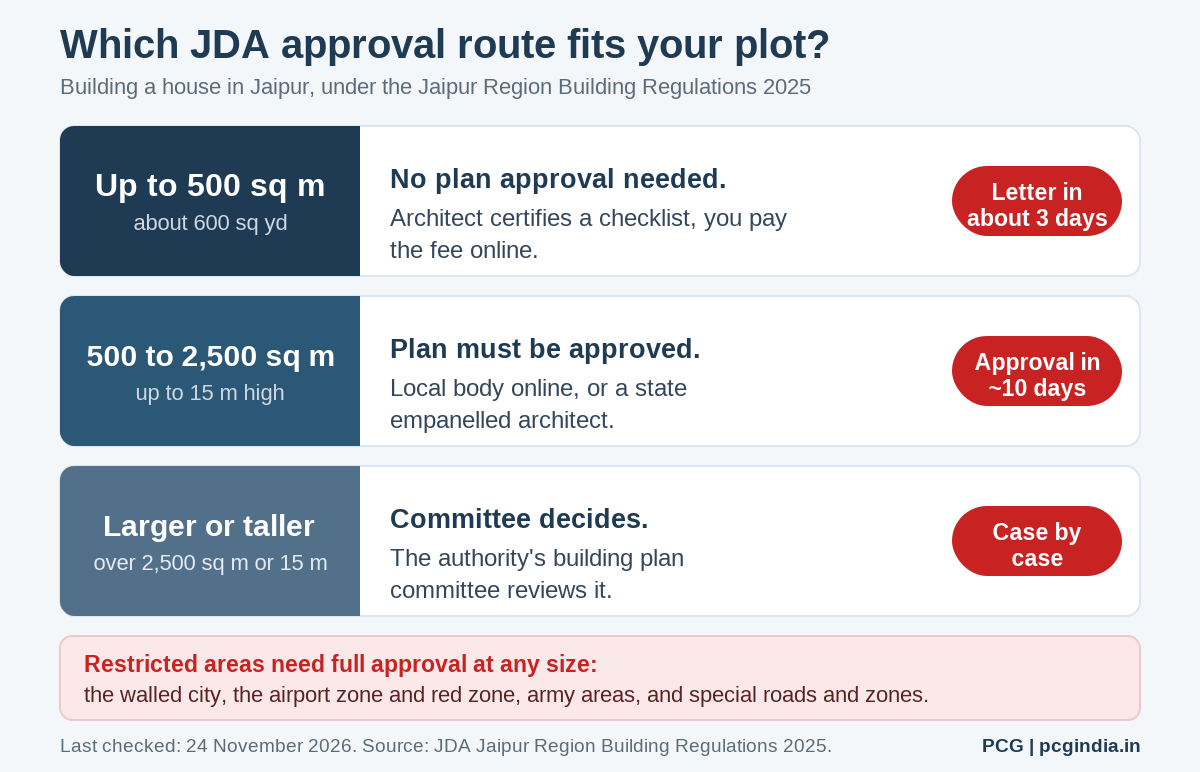
The size relief stops in the restricted areas, where full approval applies at any plot size. These include the walled city, land within 2 kilometres of the airport or in its red zone, land near army areas, and special roads and zones. If your plot sits in one of these, treat it as a full-approval case and ask the JDA zone office early.
Who signs off your house map, by plot size
Past 500 square metres, someone has to approve the plan. Who, and how fast, depends on the size.
| Plot size | How building permission works | What the rules promise |
|---|---|---|
| Up to 500 sq m (about 600 sq yd) | No plan approval. Your architect certifies the checklist, you pay the fees | Acknowledgement letter in about 3 days |
| 500 to 2,500 sq m, up to 15 m high | Online application to the local body, or approval by a state empanelled architect | Local body: 15 working days to scrutinise, approval within 10 working days of payment. Architect: acknowledgement within 7 days |
| Larger or taller buildings | The authority’s building plan committee decides | Above 60 m in a development authority city, the state government gives final approval |
One line in the fine print protects you: if the local body sits on a complete, paid application beyond its 10 working days, the regulations say compliant construction is not treated as unauthorised. You are not meant to wait forever.
How to apply for JDA building plan approval online
JDA runs building permission through the Rajasthan single sign-on portal, the same login you use for patta and conversion services. The national services portal confirms the online route, from uploading the drawings to paying the fee and tracking the file. Your architect usually drives most of it, so appoint one before you start.
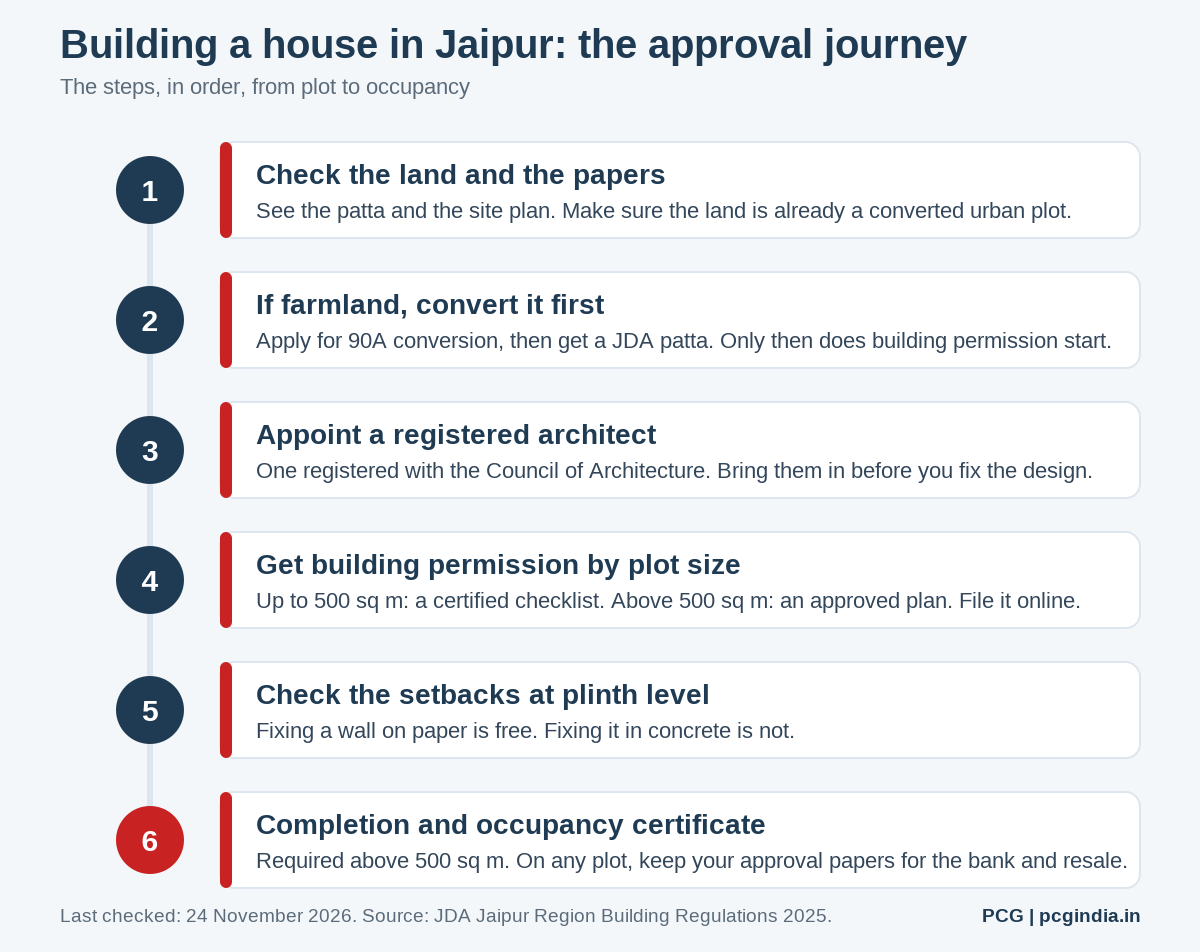
- Appoint a registered architect first. The plan must be drawn and signed by an architect registered with the Council of Architecture. Bring them in before you fix the design, not after.
- Confirm the plot is a converted, patta plot. If the land is still agricultural in the record, it needs 90A conversion and a JDA patta before any building permission. If you are still buying, run the due diligence checks first.
- Sign in at the Rajasthan SSO portal. Create or use your SSO ID, then activate JDA’s building plan approval service. There is a one-time registration fee of about 500 rupees, valid for five years.
- Let the architect file the plan. They prepare the drawings and the checklist, upload your documents, and you pay the approval fees online. The fee depends on the plot size and use, so ask for the figure for your plot.
- Submit the hard copy where asked. For cases that need it, a signed hard copy goes to the JDA Citizen Care Centre. Keep every receipt.
- Collect your acknowledgement or sanctioned plan. For the small-plot route it is the acknowledgement letter. For larger plots it is the approved drawing set. File it with your patta papers.
What your architect will ask you for
Gather these before the first meeting, so the filing does not stall:
- The patta or lease deed in the current owner’s name.
- The approved site plan or scheme map with your exact plot marked.
- The latest land record (jamabandi and khasra) where the plot’s history calls for it.
- Your ID, usually Aadhaar and PAN, and your SSO login.
- An affidavit in the format the rules prescribe, and any no-dues or clearance the regulations list for your case.
If a seller or a middleman cannot produce the patta and the site plan, that is a reason to pause, the same warning sign we flag in our patta guide.
The steps people skip: plinth check and completion
Approval is the start, not the finish. Two later steps decide whether your paperwork holds up.
The plinth check comes first. The regulations group buildings by risk: low risk up to 500 square metres and 15 metres, medium up to 2,500 square metres, and high above 15 metres. A registered architect can carry out the plinth inspection for the medium and high groups. Our own advice is plainer: on any plot, have someone confirm the setbacks at plinth level, because moving a wall on paper is free and moving it in concrete is not.
Then the completion and occupancy certificates. Regulation 15.1 makes both compulsory for flats, group housing and plots above 500 square metres. For a single house on a smaller plot they are not required.
That sounds like one less job, and it is. But keep the acknowledgement letter or the approved drawings somewhere safe anyway, because a home loan lender asks for them, and so does the next buyer when you sell.
Building against the plan costs more than approval
It is tempting, on the no-approval route, to read “no approval needed” as “no one is checking”. The regulations are blunt about this: anything built against the setbacks, height or ground coverage is unauthorised, with or without a stamped plan.
The bill comes later. Unauthorised work can draw a notice or a demolition order, it is slow and costly to regularise, and it quietly blocks two things most owners need: a bank loan against the house, and a clean sale. A house that matches its sanctioned plan, or its certified checklist, is worth more than one that does not, before you count a single rupee of construction.
If you have a plot and are not sure which route it takes, send us the patta and the site plan and our advisory team will point you to the right step. You can reach us on our contact page.
Questions people ask
Do I need JDA building plan approval for a house on a 200 square yard plot?
Not a plan approval, if the plot is up to 500 square metres and outside a restricted zone. Your architect certifies a checklist, you pay the fee online, and JDA sends an acknowledgement letter. The setbacks, height and ground coverage still apply, so the house must be drawn to them.
What is the plot size limit for the no-approval route in Jaipur?
500 square metres, which is about 600 square yards or 598 gaj. At or below that size, outside the walled city, the airport zone and other special areas, regulation 13.4 of the Jaipur Region Building Regulations 2025 lets you build on a certified checklist instead of a sanctioned plan.
Who can approve a building plan in Jaipur?
For plots of 500 to 2,500 square metres up to 15 metres high, either the local body after an online application, or a registered architect empanelled with the Chief Town Planner, Rajasthan. Larger or taller buildings go to the authority's building plan committee. In every case a Council of Architecture registered architect draws and signs the plans.
How long does JDA building plan approval take?
For the no-approval route, JDA is to send an acknowledgement within about three days. For a plot of 500 to 2,500 square metres, the local body has 15 working days to scrutinise and is to approve within 10 working days of payment, while the architect route gives an acknowledgement within seven days. Add the time to prepare drawings and gather papers.
Do I need a completion certificate for my own house?
Regulation 15.1 makes the completion and occupancy certificates compulsory for flats, group housing and plots above 500 square metres, not for an independent house on a smaller plot. Even so, keep the acknowledgement letter or the approved drawings safe, because banks and future buyers ask for them.
Is JDA approval the same as 90A land conversion?
No. These are two separate permissions, in order. If the land is still agricultural, it first needs conversion under section 90A, which turns it into a leased urban plot with a patta. Building permission comes after that. Our guide to 90A and 90B explains the first step.
What happens if I build without approval in Jaipur?
Anything built against the setbacks or the height limit is unauthorised, even on the no-approval route. It can face notice or demolition, it is hard to regularise, and it blocks a home loan and a clean resale. Build to the sanctioned plan or the certified checklist, and check the setbacks at plinth level.
Sources
- JDA: Jaipur Region Building Regulations 2025 (Rajasthan Gazette, 25 August 2025)
- JDA: notification of 26 May 2026 correcting the Jaipur Region Building Regulations 2025
- JDA online citizen services (building plan approval, patta, conversion)
- Rajasthan SSO: single sign-on for JDA online services
- UDH Rajasthan: building bye-laws, including the Model Rajasthan Building Regulations 2025
- India.gov.in: Building Plan for Permission of Construction in Rajasthan (national services portal)
- Economic Times Realty, 17 July 2025: Rajasthan's new building bylaws and smaller setbacks
Good to know. This guide is general information and not legal advice. Rules, fees and procedures change, so confirm the current position with the issuing authority or a lawyer before you decide.
Written by the PCG advisory team
Propex Consulting Group helps buyers, sellers and tenants in Jaipur with verified plots, homes and commercial space. Questions about this guide? Call us or send an enquiry.
+91 99299 37185