
Commercial lease in Jaipur: lock-in, deposit, rent increase and exit
How a commercial lease in Jaipur really works: what lock-in, security deposit, rent increase and exit clauses mean, plus stamp duty on the lease deed.
PCG advisory team
Propex Consulting Group
Leasing guide
PCG · Jaipur
Short answer
A commercial lease in Jaipur is built around four terms: a lock-in period, when neither side can leave without a penalty; a security deposit, usually several months' rent; a rent increase at fixed intervals; and an exit clause setting the notice period. You must register any lease longer than one year, and the tenant usually pays the stamp duty, which in Rajasthan rises with the length of the lease.
In this article
- What does a lock-in period mean, and who does it really protect?
- Can your landlord raise the rent during the lease?
- How much is the security deposit, and when do you get it back?
- What happens if you break a commercial lease early?
- How long can a commercial lease in Jaipur run, and why it must be registered
- Stamp duty on a lease deed in Rajasthan
- Do not forget GST on the rent
- Questions people ask
- Sources
You have agreed the rent on a shop or an office in Jaipur, and the owner sends over a lease to sign. The rent is the easy part. Four other clauses decide whether a commercial lease in Jaipur works for your business or ties your hands: the lock-in period, the security deposit, the yearly rent increase, and how you are allowed to leave.
Get these wrong and you can end up paying for space you have already walked out of. This guide explains what each one means, what the law in Rajasthan actually says, and where to push back before you sign.
What does a lock-in period mean, and who does it really protect?
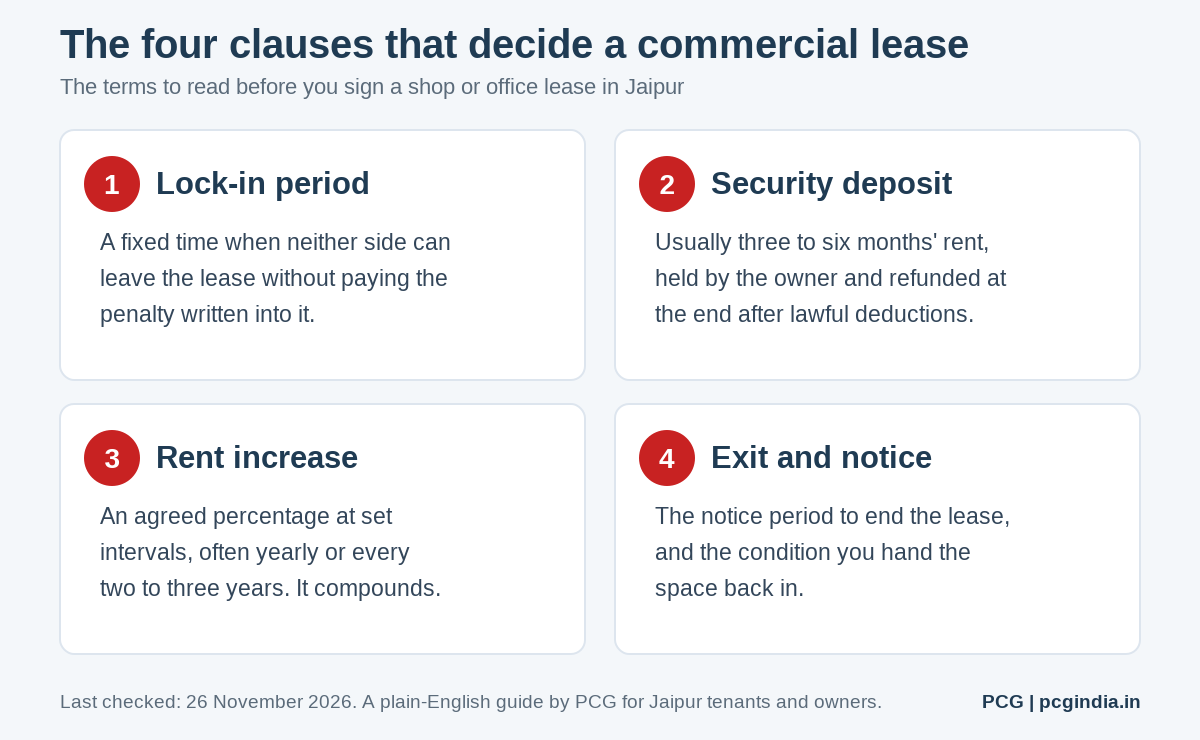
A lock-in period is a fixed stretch of time, usually at the start of the lease, when neither side can end the agreement without paying the penalty written into it. No law in India defines a lock-in or sets its length. It lives entirely in your lease, which is exactly why the wording matters.
Most tenants assume the lock-in is there to trap them. Often it is. A landlord who gives you a long lease wants certainty the rent will keep coming, especially after turning away other tenants or paying for a fit-out.
But a lock-in can cut both ways. A mutual lock-in, binding on the owner too, stops the landlord from evicting you a year after you have spent on interiors and built up footfall. If you are the one investing in the space, ask for the lock-in to bind both sides, not just you.
How long is normal? Commercial lock-ins commonly run one to three years inside a longer lease. On our own listing for SKL Tower on Vaishali Marg, the owner’s preference is a nine year lease with a lock-in, which is typical when one business takes a whole building. The longer and more custom the fit-out, the longer the lock-in a landlord tends to ask for.
Here is the part that catches tenants out. If you break the lease during the lock-in, the sum named in the lease is not automatically what you pay. Under section 74 of the Indian Contract Act, 1872, a court awards reasonable compensation up to that amount, and can scale an extravagant, one-sided penalty down.
That does not make a lock-in soft. You stay liable, usually for the rent across the remaining lock-in months. So read the clause with a lawyer before you sign, not after you want to leave.
If a long lock-in worries you, negotiate a way out inside it. Ask for a right to exit after the first year on longer notice and a fixed sum, or a penalty that steps down as the lease runs. A landlord who wants your business will often agree to one of these.
Can your landlord raise the rent during the lease?
Only in the way the lease allows. A registered commercial lease fixes the rent increase in advance: a set percentage at set intervals, often five or ten per cent, either every year or every two to three years. Once you both sign, the landlord cannot raise the rent beyond it during the term. If there is no written escalation clause and no registered lease, you stand on far weaker ground, which is one more reason to register.
Read the escalation as a number over the whole term, not a line in isolation. Ten per cent every year compounds. A rent of ₹1,00,000 a month rising ten per cent each year reaches about ₹1,77,000 by the seventh year.
The same ten per cent every three years is far gentler. Over a nine year lease that gap runs into lakhs of rupees, so this one clause deserves a calculator and a cool head.
How much is the security deposit, and when do you get it back?
For commercial space the deposit is usually several months’ rent, commonly three to six months, sometimes more for a prime address or where the landlord is funding part of your fit-out. It is interest free, the owner holds it, and you get it back at the end after lawful deductions.
The deposit is rarely the problem. Getting it back is. Pin down three things in writing: what the owner may deduct, how long they have to return it after you hand the space back, and what counts as fair wear against damage you must pay for.
A deposit worth six months’ rent, returned ninety days late with vague deductions, is a real cost to your business. Tie the refund to the handover condition you agree, and photograph the space on the day you take possession.
What happens if you break a commercial lease early?
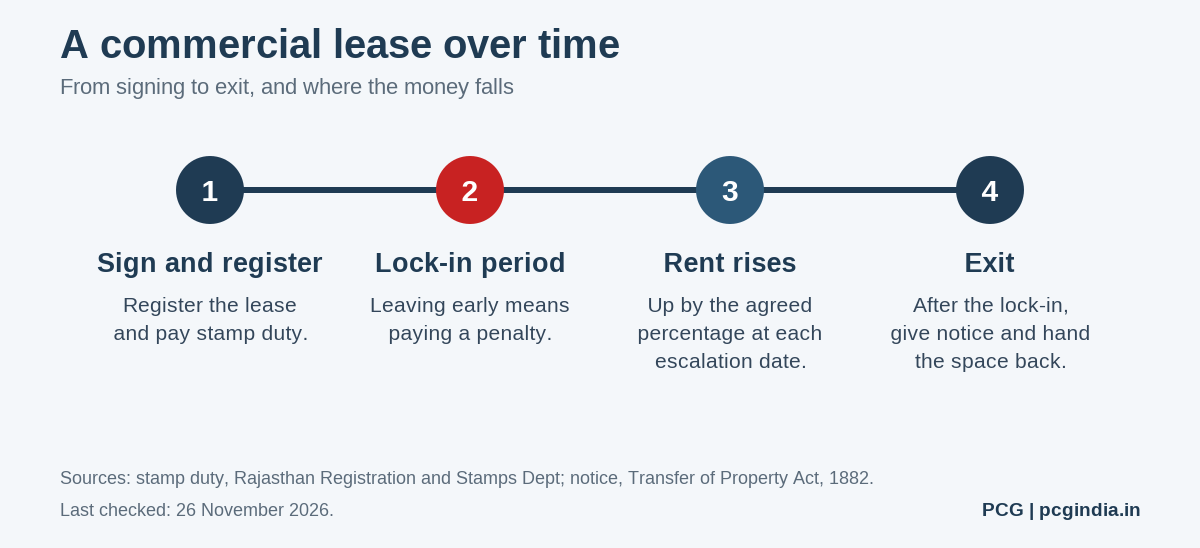
It depends on where you are in the lease. After the lock-in, you give the notice the lease requires and leave. During the lock-in, you owe the penalty, usually the rent for the remaining lock-in months or forfeiture of the deposit, subject to the section 74 point above.
If the lease is silent on notice, the Transfer of Property Act, 1882 fills the gap. Under section 106, the law treats a lease for any purpose other than agriculture or manufacturing, which covers a shop, an office or a showroom, as running month to month. Either side can end it with fifteen days written notice, counted from the day the other party receives it. Most proper commercial leases set a longer notice, often one to three months, so read your own clause rather than relying on the default.
Before you sign, look at the exit as hard as you look at the rent. Check the notice period, the condition you must return the space in, whether you can take your fit-out with you, and whether you can assign or sub-let if your plans change. Our guide to leasing a commercial building on Vaishali Marg has a fuller pre-signing checklist and explains the area, parking and signage points to confirm.
How long can a commercial lease in Jaipur run, and why it must be registered
There is no legal maximum. The Transfer of Property Act defines a lease as the transfer of the right to enjoy property for a term, and that term can be a few years or run in perpetuity. In practice commercial leases in Jaipur are commonly signed for three, five or nine years, often with a renewal option.
The length changes your paperwork. You must register any lease longer than one year under section 17 of the Registration Act, 1908. A registered lease is the version a court will rely on, so for anything beyond a short arrangement, register it.
This is why so many small rentals use an eleven month agreement: it slips under the one year line and avoids registration. For a serious commercial space, that saving is false economy.
Stamp duty on a lease deed in Rajasthan
Registration brings stamp duty, and this is the cost tenants forget to budget. In Rajasthan the stamp duty on a lease deed rises with the length of the lease, as set out in the Registration and Stamps Department rate card.
| Lease term | Stamp duty |
|---|---|
| Less than 1 year | 0.02% |
| 1 to 5 years | 0.1% |
| 5 to 10 years | 0.5% |
| 10 to 15 years | 1% |
| 15 to 20 years | 2% |
| 20 to 25 years | 4% |
| 25 to 30 years | 4% |
| More than 30 years | 6% |
So an eleven month agreement attracts only a token rate, a nine year lease falls in the 0.5 per cent band, and a very long lease costs far more. The sub-registrar charges the duty on the lease consideration, broadly the rent and any premium, and a registration fee applies on top. Confirm the exact base and fee with the Registration and Stamps Department or your lawyer for your own figures, since the rates can change.
The lease should say plainly who pays the stamp duty and the registration fee, because by custom the tenant usually does, and it is better agreed than assumed. The same rate card sets the stamp duty on a sale, which we cover in our guide to plot registry charges in Jaipur.
Do not forget GST on the rent
Commercial rent carries GST at 18 per cent, unlike residential rent, which is exempt. If your landlord is registered, they add the GST to your rent, and you claim it as input credit where your business allows. Since October 2024, where an unregistered landlord lets commercial property to a GST registered tenant, the tenant pays that GST directly under reverse charge, a change the GST Council confirmed through the Central Board of Indirect Taxes and Customs. Factor the 18 per cent into your real monthly cost, not just the headline rent.
If you are weighing a commercial space in Jaipur, read the lock-in, the escalation, the deposit return and the exit clause together, with a lawyer, before you sign anything. Send us the draft lease and the building details and our advisory team will tell you where the terms look fair and where to push back. You can reach us on our contact page.
Questions people ask
Is a lock-in period legal in India?
Yes. No statute defines it, but courts enforce a reasonable lock-in as a term of the contract. If you leave early, section 74 of the Indian Contract Act, 1872 limits the landlord to reasonable compensation up to the sum named in the lease, not any arbitrary figure.
Do I have to pay stamp duty on a rent agreement in Jaipur?
Yes, on the lease deed. In Rajasthan the rate rises with the term, from a token rate under one year to 0.5 per cent for a five to ten year lease, and more above that. A registration fee applies too. Confirm the exact figures with the Registration and Stamps Department.
Can a landlord increase commercial rent during the lease?
Only as the lease allows. A registered lease with a fixed escalation clause binds the landlord to that increase and no more during the term. Without a written clause you have far less protection.
What notice do I have to give to leave a commercial lease?
Whatever the lease says, often one to three months. If the lease is silent, section 106 of the Transfer of Property Act treats a commercial tenancy as month to month, which either side can end with fifteen days written notice.
How many months' deposit is normal for a commercial lease?
Commonly three to six months' rent, sometimes more for a prime location. It is interest free and refundable at the end after lawful deductions, so agree the deduction and return terms in writing.
What is the difference between a lease and a leave and licence?
A lease transfers the right to occupy the space for a term, and beyond one year you must register it. A leave and licence only permits use and does not transfer that interest. In Jaipur you usually take commercial space on a lease, so read which one you are signing.
Is GST charged on commercial rent?
Yes, at 18 per cent, while residential rent is exempt. Since October 2024 a GST registered tenant renting from an unregistered landlord pays that GST directly under reverse charge.
Sources
- Rajasthan Registration and Stamps Department: Rate of Stamp Duty and Registration for major articles (lease deed rates)
- Transfer of Property Act, 1882, section 105 (lease defined)
- Transfer of Property Act, 1882, section 106 (notice to end a lease)
- Registration Act, 1908, section 17 (documents of which registration is compulsory)
- Indian Contract Act, 1872, section 74 (compensation for breach where a penalty is named)
- CBIC: circular on GST on renting of commercial property (reverse charge)
Good to know. This guide is general information and not legal advice. Rules, fees and procedures change, so confirm the current position with the issuing authority or a lawyer before you decide.
Written by the PCG advisory team
Propex Consulting Group helps buyers, sellers and tenants in Jaipur with verified plots, homes and commercial space. Questions about this guide? Call us or send an enquiry.
+91 99299 37185